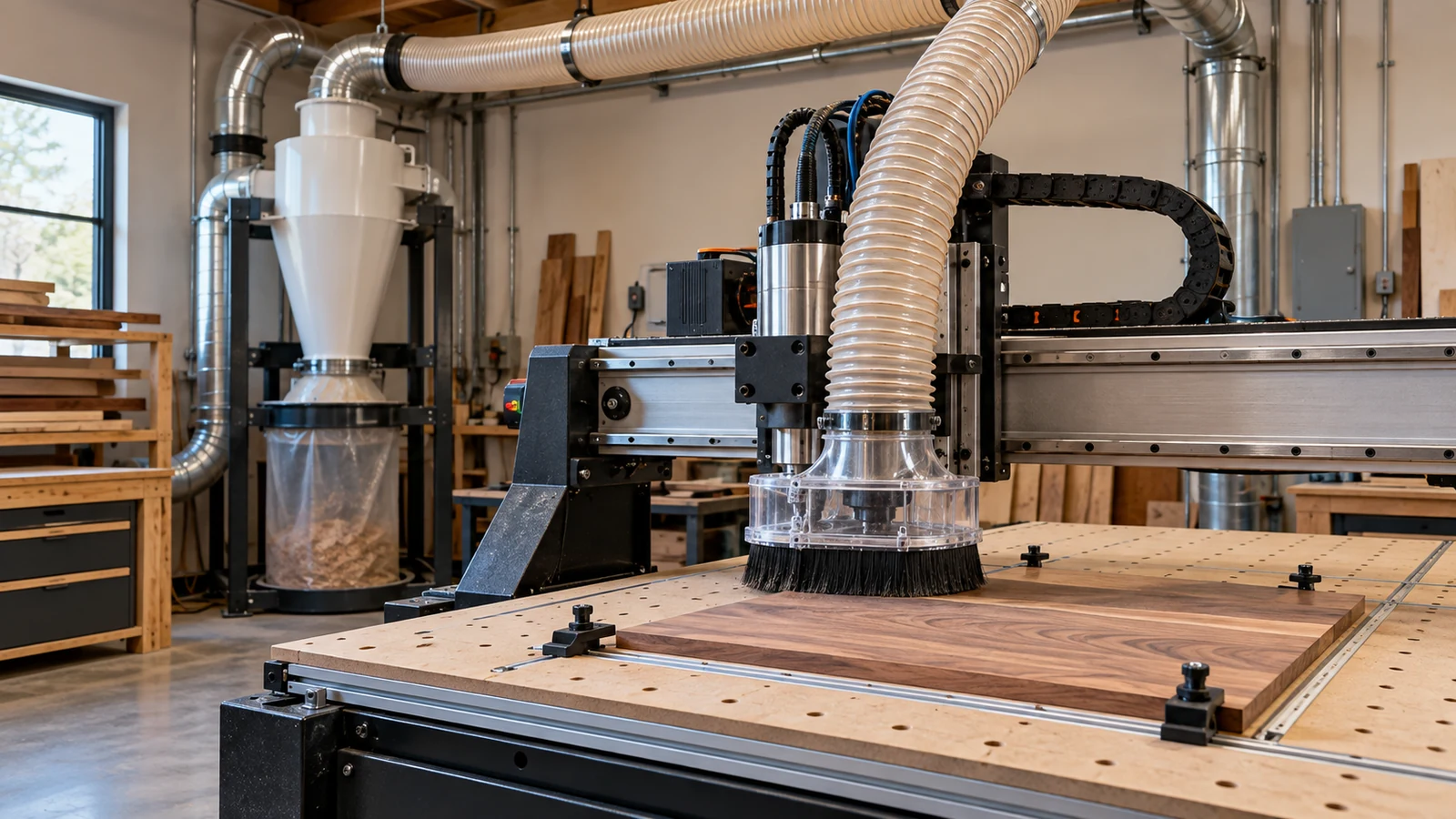
For a home CNC shop, buy an extinguisher whose label lists the classes you face: Class A for wood and paper, Class B for oils and greases, and Class C for energized electrical equipment. Add working smoke or heat alarms, keep dust under control and ask your local fire department for guidance. Combustible metals such as magnesium and titanium are a special case that needs specialist advice.
Start with what can burn
OSHA's definitions give a useful vocabulary. Class A fires involve ordinary combustibles like paper, wood and cloth. Class B involves flammable or combustible liquids, flammable gases and greases. Class C involves energized electrical equipment, where safety requires a nonconductive extinguishing agent. Class D involves combustible metals such as magnesium, titanium, zirconium, sodium, lithium and potassium.
| Shop hazard | OSHA class | Label must show |
|---|---|---|
| Wood, MDF, paper, rags | A | Class A rating |
| Oils, greases, other flammable or combustible liquids | B | Class B rating |
| Controllers, power supplies, spindle drives | C | Class C rating |
| Magnesium or titanium shavings | D | Class D agent |
Many extinguishers carry more than one class on the label, so read the label rather than the name on the box. Do not use water on energized electrical equipment, since Class C is defined by the need for a nonconductive agent.
Dust is the fire you can prevent
OSHA's combustible dust page says any combustible material can burn rapidly in finely divided form and that dust suspended in air can become explosive under certain conditions. It lists wood and metals such as aluminum, iron, magnesium and zinc as materials that can form explosive dust. In a CNC shop that means collecting dust at the cutter, keeping it from piling up and not relying on an extinguisher alone.
Our guides on dust shoes, cyclone separators and grounded vacuum hoses explain how to keep dust under control. Carbide 3D notes that a grounded hose is often necessary in low-humidity environments, which matters because static is one possible ignition source to manage.
Metal chips and Class D
OSHA's workplace rule says Class D extinguishers or containers of Class D agent are required only where combustible metal powders, flakes or shavings are generated at least once every two weeks, and must be within 75 feet of the working area. Wood, plastic and aluminum are not on OSHA's Class D list, though fine dust is a separate hazard, covered above. If you cut magnesium or titanium, get advice from your fire department and your material supplier before you start, because the right agent and storage are specialized.
Read the label for the classes the extinguisher is rated for and follow the maker's mounting and inspection instructions.
Where to put it
OSHA's workplace limits are 75 feet of travel to a Class A extinguisher and 50 feet to a Class B one, with Class C following the pattern for the A and B hazards present. Those are outer limits for workplaces. In a small home shop, mount the extinguisher near the exit path where you can reach it without crossing the machine or the dust collector, because those are the likeliest places for a fire to start. This placement advice is ours, not an OSHA requirement for home shops.
Keep it ready
OSHA requires employers to inspect extinguishers visually every month and to do an annual maintenance check, and to train employees on extinguisher use and the hazards of incipient-stage firefighting. Home shops are not workplaces, but the habits are good ones: check the gauge or indicator monthly, follow the label for service and replacement, and learn how yours works before you need it. Ready.gov advises contacting your local fire department for guidance on proper use and maintenance.
An extinguisher is for the earliest stage of a fire. If a fire is growing, get out and call emergency services.
Alarms
Alarms only help if they are working. Write the install date on or beside each one, set a calendar reminder for battery changes and replacement, and test them using the maker's method.
Ready.gov says to install smoke alarms on every level of a home, to replace batteries twice a year unless you use 10-year lithium batteries, and to replace the whole unit every 10 years or as the maker directs. For a garage or shop, read the alarm's manual for where not to mount it, since dust and fumes can foul or trigger some alarms, and ask your fire department whether a heat alarm suits the space. No alarm-type performance claims are made here.
Check the alarm's manual for suitable locations, power source and replacement date before you mount it.
Ten-minute shop fire audit
- Can you see and reach the extinguisher from the exit without crossing the machine?
- Is the label readable and does it list the classes you need?
- Do the alarms have a written install or replacement date?
- Is dust cleaned from the machine, floor, ledges and collector, not just the cutting area?
- Are oily rags, solvents and coolant stored as the product label and your fire department advise?
- Is there a clear path to the door, and does everyone who uses the shop know it?
Plan the exit too. Know the fastest way out of the shop from each side of the machine, keep a phone within reach and agree who calls emergency services. An extinguisher is a tool for a small, early fire, and getting everyone out matters more than saving equipment.
Link the rest of your safety plan
- Know where your power disconnect and emergency stop are.
- Keep oily rags and cardboard away from the machine.
- Keep heaters away from dust; see our cold garage checklist.
- Never leave the machine running unattended, as Carbide 3D's safety guidance says.
For more detail, see our fire safety page and dust and fume control page.
Frequently asked questions
What class of fire extinguisher do I need for a CNC shop?
Most shops need Class A for wood and paper, B for oils and greases and C for energized electrical gear. A multipurpose label may cover all three.
Do I need a Class D extinguisher for aluminum?
OSHA's Class D list names magnesium, titanium, zirconium, sodium, lithium and potassium. If you work with combustible metals, ask your fire department and supplier.
Can wood dust cause a fire or explosion?
OSHA says wood is among materials that can burn rapidly in finely divided form and can form explosive dust. Control dust at the source and clean regularly.
Should I use a smoke alarm or a heat alarm in a garage?
Read the alarm's manual for approved locations and ask your fire department. Dust and fumes can affect some alarms.
How often should I check my fire extinguisher?
OSHA requires monthly visual checks and annual maintenance in workplaces. Home users should follow the label and consult the fire department.
Class definitions and workplace extinguisher rules come from OSHA, dust hazards from OSHA's combustible dust page, alarm basics from Ready.gov and grounding from Carbide 3D. OSHA rules apply to workplaces, so home use is guidance. This is not fire-protection engineering advice; confirm product ratings on the extinguisher label and follow your local fire department's guidance.