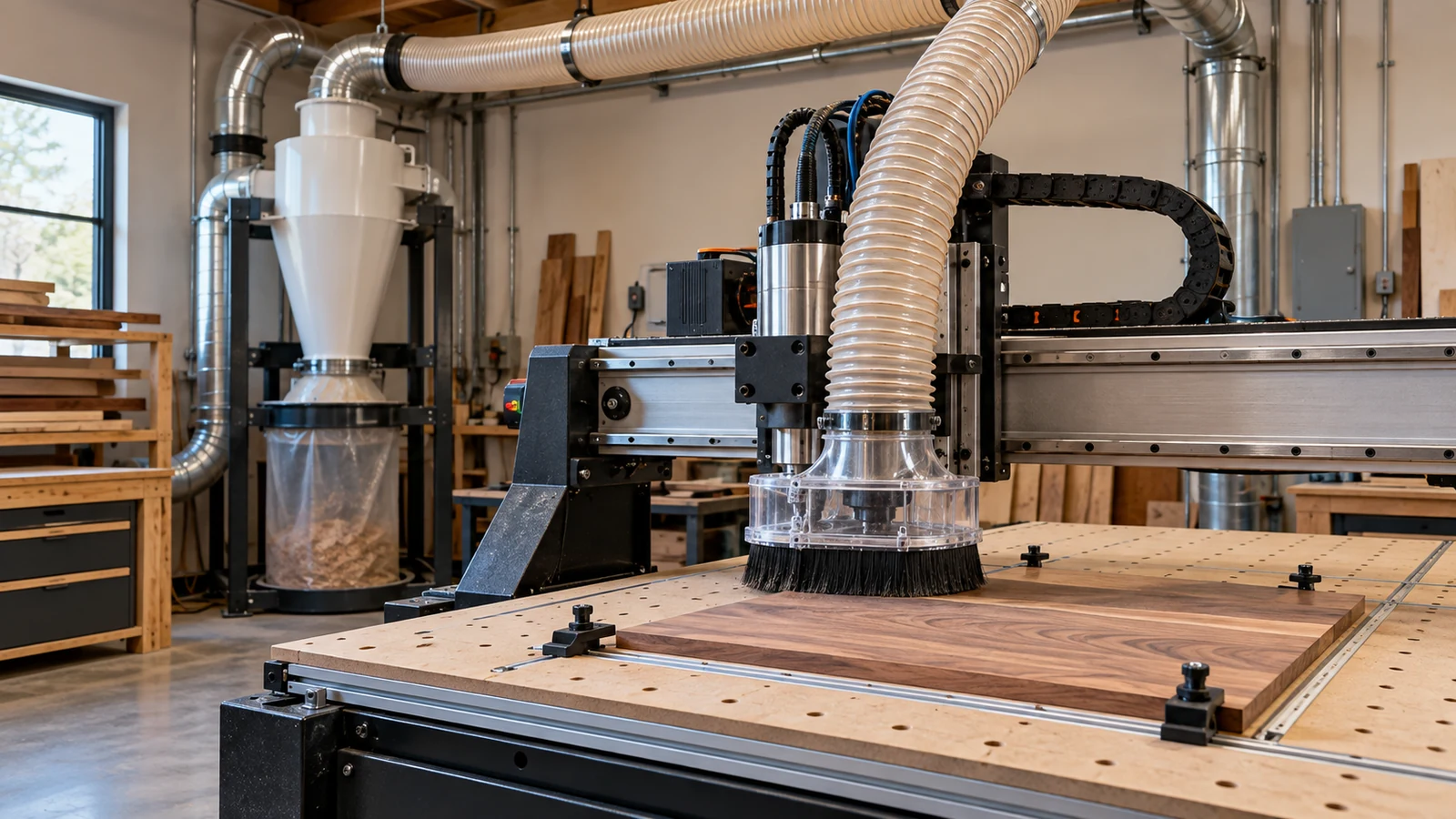
A shop vac is the usual starting point for a desktop CNC router, and it can work well when paired with a dust shoe and a cyclone. A dust extractor costs more but is built for fine dust, long runs and cleaner emptying. Pick the vac if jobs are short and you add a pre-separator. Pick the extractor if you run long programs, cut MDF or composites often, or work in a living space.
What the two machines are built to do
A shop vac is designed to pick up debris and liquid in bursts. A dust extractor is designed to capture fine dust from tools for long periods, with finer filtration and, usually, a hose and fittings meant for continuous duty. Both move air. The differences show up in what happens to the fine dust once it is inside, and in what they do to the shop after an hour of running.
For a CNC router the job is unusual. The spindle and shoe are fixed to a moving gantry, the airflow has to pass through a flexible hose, and the cut can run for hours with no one pressing a trigger. That is closer to an extractor's job than a vac's, but plenty of shops make a vac work.
Airflow, suction and the dust shoe
Suction (the pull at a sealed opening) and airflow (the volume of air that moves) are different things. A dust shoe has a small gap at the bottom, so airflow and a tight skirt matter more than peak suction. Long, narrow or crushed hoses cut airflow quickly. Rated numbers on a box are measured under test conditions that do not match your hose run, so treat them as a rough comparison and check how the seller defines them.
What to compare in practice:
- Hose diameter and the fitting at the vacuum end.
- Whether the unit holds its pull as the filter loads with dust.
- Whether you can add a pre-separator without a tricky adapter.
Filtering and clogging
Fine router dust blinds an ordinary paper or cloth filter fast. When the filter clogs, airflow drops, the shoe collects less, and dust ends up in the room. Extractors typically use finer filters and often have a cleaning mechanism, but the specifics differ by maker and model, so read the manual. If you stay with a vac, a cyclone (see our cyclone separator guide) ahead of it keeps most of the bulk out of the filter, which is the main reason cyclone add-ons exist.
Look for filter replacement availability. A model whose filters are discontinued or expensive becomes a bad purchase after the first season.
| Shop vac | Dust extractor | |
|---|---|---|
| Fine dust handling | Needs a good filter and a pre-separator | Built around fine dust; check the manual for its filter type |
| Duty cycle | Meant for bursts; check the maker's run guidance | Meant for longer use; check the manual |
| Hose and fittings | Common sizes, many adapters | Often a fitting system of its own |
| Noise | Usually loud; some models are quieter | Varies; check the listing |
| Emptying | Messy unless you add a bag or bin | Often a bag or clean-out system |
| Cost to start | Lower | Higher |
Check hose diameter, filter type and replacement filters in each listing, and compare it to your dust shoe's fitting.
Hoses, fittings and static
Hose mismatches are the most common surprise. Carbide 3D's setup documentation says the user must supply a shop vacuum with a connector sized for their dust shoe hose. Vac and extractor hoses come in different diameters, and the fitting at the shoe is not the same on every machine, so measure before buying. Our dust shoe guide covers the shoe side.
Static is the other hose issue. Moving dust in a plastic hose can build static charge, and Carbide 3D says a grounded hose is often necessary, especially in low humidity. If your machine's maker calls for grounding, follow the maker's instructions and read our grounded hose guide. Any grounding wiring beyond a plug-in accessory belongs with a qualified electrician.
Hose handling is the last detail. A heavy, stiff hose pulls on the dust shoe and can load the gantry or snag on clamps as the machine moves. Leave enough slack for the whole travel, support the hose from above or the side so its weight does not hang on the shoe, and keep it out of the path of the gantry and cables. Check for kinks, and replace a hose that has split, since leaks cost airflow just as a clogged filter does.
Automatic start and the power question
Extractors often have a switched outlet that starts the vacuum when a connected tool turns on. Whether that helps depends on how your spindle is powered. A router plugged into a controller-managed outlet may work with it; a spindle on a separate supply may not. Do not rewire anything to make it happen. Check what the controller and the extractor manuals support, and ask a qualified person if the answer involves modifying mains wiring. A simple option is to start the vac by hand before each job and use a timer or remote only if its rating suits the vacuum.
Fire and metal chips
OSHA says any combustible material can burn rapidly in finely divided form, and that suspended dust can be explosive. Aluminum and other metal dusts are on its list. Do not run a general-purpose vac that is not rated for metal chips or sparks while cutting metal, and check the maker's manual for what the unit may collect. Empty fine dust regularly and keep the vac away from the spindle's heat. Our fire extinguisher and alarm guide covers the rest of that plan.
How to choose
There is no single right answer; the best match depends on how long you run, what you cut and where the machine lives.
- Short jobs, tight budget: shop vac, dust shoe and a cyclone ahead of it.
- Long jobs or MDF: extractor, or a vac with a high-quality filter and a cyclone, plus a respirator. See our respirator guide.
- Shared living space: quieter, sealed, finer filtration.
Frequently asked questions
Can a shop vac run a CNC router dust shoe?
Yes, many shops use one, but it needs a hose that fits the shoe and a filter that copes with fine dust. A cyclone ahead of it keeps the filter from clogging as fast.
Is a dust extractor worth it for a hobby CNC?
It is worth considering if you run long jobs, cut MDF or composites, or work near living space. For short jobs a vac with a cyclone often does enough.
Do I need a grounded hose?
Carbide 3D says grounding is often necessary on its machines, especially in low humidity. Check your machine maker's instructions and use a qualified electrician for any wiring.
Can I vacuum metal chips with my shop vac?
Check the vacuum's manual first. Not every unit is rated for metal chips or sparks, and fine metal dust can be combustible.
Hose-fit, grounding and dust-collection statements come from Carbide 3D's documentation, and combustible-dust statements come from OSHA. We make no airflow, suction or filter-rating claims because they vary by model and test method; compare them in each maker's spec sheet. Whether a vacuum may collect metal chips, run continuously or be started by a controller outlet is specified in that vacuum's and machine's manuals.